


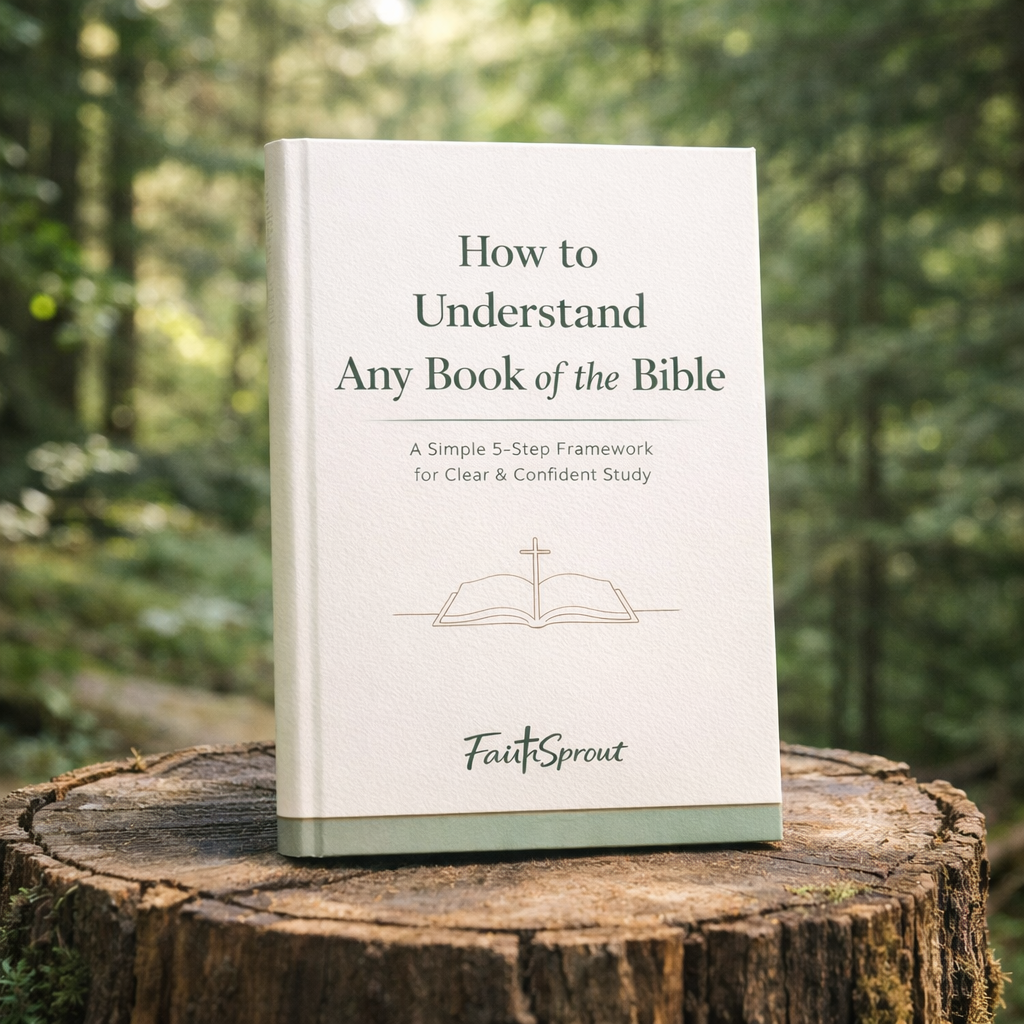
How To Understand Any Book of The Bible E-Book
How To Understand Any Book of The Bible E-Book
Couldn't load pickup availability
Get it between - and -.
- American express payment method
- Apple pay payment method
- Bancontact payment method
- Diners club payment method
- Discover payment method
- Google pay payment method
- Master payment method
- Mbway payment method
- Paypal payment method
- Shopify pay payment method
- Visa payment method
Shipping & Return
Shipping & Return
Orders are processed within 2–3 business days. Once shipped, delivery typically takes 7–11 business days within the US and 9–13 business days internationally.
You’ll receive a tracking number via email as soon as your order is on the way.
If you have any questions about your order, feel free to reach out at support@faithsprout.store — we’re happy to help.
What's inside?
What's inside?
This 66-page Bible Study Guide provides a clear overview of every book of the Bible. Each page includes the author and timeline, a chapter-by-chapter breakdown, key themes and symbolism, original audience context, and practical insights to help you understand the message of each book. Alongside every overview is a blank note-taking section, giving you space to write reflections, key verses, and insights as you read through Scripture.
Love it or your money back
Love it or your money back
Try our Bible Study Guide risk-free for 30 days.If it doesn’t deepen your understanding or strengthen your faith, send it back. No questions asked! We back it with a hassle-free money-back guarantee.
Six layers of context.
On every single page.
Every one of the 66 pages follows the same proven structure — the same six elements that turn confusing ancient texts into clear, connected truth. No skipped books. No missing pieces. No seminary degree required.
The Author & Timeline
Who wrote this book, when they wrote it, and what was happening in the world the moment the words were first put down.
Original Audience Context
Who this book was written for and why — the cultural reality that made every line land with weight the original readers couldn't miss.
Chapter-by-Chapter Breakdown
A clear walkthrough of every chapter so you always know where you are in the story and what you're about to read next.
Key Themes
The major threads running through each book — the recurring ideas God is weaving into the larger story of Scripture from beginning to end.
Symbolism & Imagery
The hidden symbols, prophetic imagery, and cultural references most readers walk right past — finally surfaced and explained.
Practical Application
How this ancient book actually connects to your modern life — what to take with you when you close the page and walk back into the world.
Here's what one of the 66 pages actually looks like
An inside look at the Exodus page — every element of the framework, highlighted on a real spread from the guide.


Most Christians have heard these words
their entire lives.
Almost none of them know what those words actually mean.
That line is not a cry of despair. It is a direct quotation. The opening verse of Psalm 22 — a psalm written by King David roughly one thousand years before Jesus was born.
Jesus was not losing His faith on the cross. He was quoting Scripture. And in ancient Jewish tradition, when a rabbi quoted the first line of a psalm, He was invoking the entire psalm. Every person standing at Golgotha who knew the Torah would have recognized exactly what He was doing.
Here is what makes that staggering. Psalm 22 was written approximately one thousand years before the Roman Empire invented crucifixion. Yet look at what David wrote:
Crucifixion did not exist when those words were written. David had no framework for it. And yet there it is — written into the Hebrew Scriptures a millennium before the method of execution that would fulfill it had ever been conceived.
Psalm 22 does not end in agony. The final verse declares total cosmic victory in a single Hebrew word: "He has done it." The same word Jesus spoke as His final breath — "It is finished."
Jesus did not die quoting the beginning of Psalm 22. He died fulfilling the end of it. Not in defeat. In victory. And most Christians have read right past it their entire lives.
I'm not going to tell you that moment is printed on the Psalms page of our guide. It isn't.
What's on that page — and on every one of the other 65 pages — is the foundation that makes moments like this discoverable. The author. The timeline. The cultural world it was written into. The themes running underneath the surface. The roots.
Because insights like the one you just read aren't hidden in a commentary somewhere. They're waiting in the text itself. You just need the context to see them.
You can keep reading past these moments your whole life.
Or you can finally see them.

John Ross
Founder, FaithSprout
I've been teaching Scripture for 18 years. And one Wednesday night I realized my own Bible study group could read a passage their entire lives and still miss what it actually said — not because their faith was weak, but because nobody had ever given them the roots. The Bible isn't confusing because it's unclear. It's confusing because we're reading it without the foundation that made it clear to the people it was first written for. That's why we built FaithSprout.
Backed by a Public Statement of Faith
Every FaithSprout product is built on a clear, traditional, biblically grounded statement of faith — published openly so you know exactly where we stand before you ever open one of our guides.
Four ways people try to study the Bible.
Only one gives you the roots.
An honest look at the most common approaches to Scripture study — what they offer, where they break down, and where FaithSprout fits.
| Reading Plans | Study Bibles | Bible Apps | FaithSprout | |
|---|---|---|---|---|
| Time per session | 20–45 minutes of dense reading on a fixed daily schedule | 30+ minutes of cross-referencing footnotes and commentary | 5 minutes of scrolling, often interrupted by notifications | 5 minutes per page — read at your own pace, no timers |
| Where you start | Genesis chapter 1, then push through book by book | Wherever you flip — usually a familiar passage | A pre-built daily verse, often without context | Any book of the Bible — each page stands on its own |
| What you walk away with | Pages read, often without comprehension or retention | Academic footnotes that can feel disconnected from real life | A streak count and a verse you may forget by lunch | Real understanding of the book's roots — author, themes, symbolism, application |
| When you fall behind | Schedule breaks down by mid-February (the "Leviticus wall") | Easy to put down for weeks without consequence or progress | A broken streak that can feel like spiritual failure | No streaks. No deadlines. Pick up exactly where you left off. |
| Best for | Disciplined readers with seminary-level patience | Pastors, scholars, and serious theology students | Quick daily reminders, not deep comprehension | Everyday believers who want to actually understand all 66 books |
FaithSprout
Reading Plans
Study Bibles
Bible Apps
Frequently Asked Questions
Is this guide suitable for beginners?
Is this guide suitable for beginners?
Yes. The guide was designed specifically to be beginner-friendly. Each page clearly explains the context, key themes, and meaning of each book of the Bible in simple language. Whether you're new to Scripture or have been reading for years, the guide helps you understand God's Word with clarity and confidence.
Does this work with my denomination?
Does this work with my denomination?
Yes. FaithSprout is intentionally built for believers across every Christian tradition — Baptist, Methodist, Catholic, Lutheran, Pentecostal, non-denominational, and beyond. We don't take sides on secondary theological debates or push any single denominational framework. Our only commitment is to the historical, cultural, and literary context of Scripture itself — the foundation every Christian tradition shares. Whatever church you worship at on Sunday, this guide is designed to deepen your understanding of God's Word, not challenge your tradition. You can also read our full Statement of Faith on our About page.
I've tried Bible study before and always quit. How is this different?
I've tried Bible study before and always quit. How is this different?
You're not alone — most people who buy Bible study tools quit within a few weeks. Usually it's not a faith problem. It's a structure problem. Traditional reading plans demand 20–45 minutes of dense reading on a fixed daily schedule, and the moment life interrupts, you fall behind and feel like a failure. The 66 Roots Journey works differently: there are no streaks, no deadlines, no "day 47 of 365" guilt. Each page stands on its own — read one when you have five minutes, or read ten in a weekend. You can start at any book, come back after a month, and pick up exactly where you left off without losing any progress. It's designed around how real people actually live, not how we wish we lived.
How is the Bible Study Guide structured?
How is the Bible Study Guide structured?
Each page gives you a clear, easy-to-follow overview of a book of the Bible so you can understand it before you begin reading. Every page includes:
Author & Timeline – See who wrote the book, when it was written, and where it fits in the biblical timeline.
Chapter Breakdown – A simple outline of the major sections so you can see the flow of the book at a glance.
Key Themes – The central ideas running through the book, explained in clear, plain language.
Symbolism & Imagery – Important biblical symbols and what they represent, helping you see deeper connections in Scripture.
Practical Application – Real ways the message of the book can apply to your life today.
Original Audience Context – Who the book was written for and why that historical context matters.
Each page can be read in just a few minutes and is designed to give you the clarity and context needed to approach the Bible with confidence.
Does this work with any Bible translation?
Does this work with any Bible translation?
Each page gives you a clear overview of a book of the Bible before you read it. It includes the author and timeline, a chapter breakdown, key themes, important symbolism, practical life applications, and the original audience context—all designed to help you quickly understand the book and read with greater clarity.
Is this good for group Bible study?
Is this good for group Bible study?
Absolutely. Many customers use the guide in Bible study groups, church classes, and small group settings. The clear summaries and reflection prompts make it easy to discuss key themes and insights together.
How long does it take to complete the guide?
How long does it take to complete the guide?
The guide is designed to be flexible. Some people work through a few books each week, while others take their time and study one book at a time. Because each page focuses on a single book of the Bible, you can move through it at your own pace.
Where do you ship from?
Where do you ship from?
The guide was designed by our team at FaithSprout in the United States. To keep the price affordable, we partner with trusted printing and fulfillment facilities that ship orders directly to customers worldwide. Once your order ships, you’ll receive a tracking number to follow your delivery.
What if I don’t love it?
What if I don’t love it?
We offer a 30-day satisfaction guarantee. If you're not happy with your purchase, simply contact our support team and we'll make it right.
Here's what believers are saying
after they finally got the roots.
Stories from Christians who picked up The 66 Roots Journey expecting another study guide — and walked away understanding Scripture in a way they never had before.